Royal Air Force
Pamela's WarThe Royal Air Force stands at the centre of the book’s wartime emotional world, not simply as a military service but as the institution that repeatedly brings danger into ordinary domestic life. Its airmen appear at the hotel between sorties, in uniform and on leave, while their aircraft fill the surrounding skies. Through them, the narrative connects national defence with private desire: young men become admired guests, beloved companions, absent husbands, and names feared in telegrams.
Wartime Service and Human Cost
The Royal Air Force is presented as a service in which life expectancy is appallingly short. Only a quarter of bomber crews survive, and the consequences are registered through the narrator’s changing future dreams as handsome young men whom she has come to like are first reported missing and then declared dead. The losses are not abstract military statistics. They remove individuals from the hotel’s social circle, interrupt possible romances, and leave the community with little information beyond the stark categories of missing or dead.
The hotel’s young visitors embody both glamour and vulnerability. Despite the shortage of petrol, servicemen still find their way there between sorties, and some promise to fly over the hotel to say hello. Their visits make the service visible as a lived presence rather than a distant national institution, but every departure carries the possibility of permanent absence. Of an original group of twenty young men who come for a drink, the number diminishes week by week; the silence surrounding their deaths makes the attrition more terrible, because the community cannot discuss the details openly.
The Low-Flying Bomber
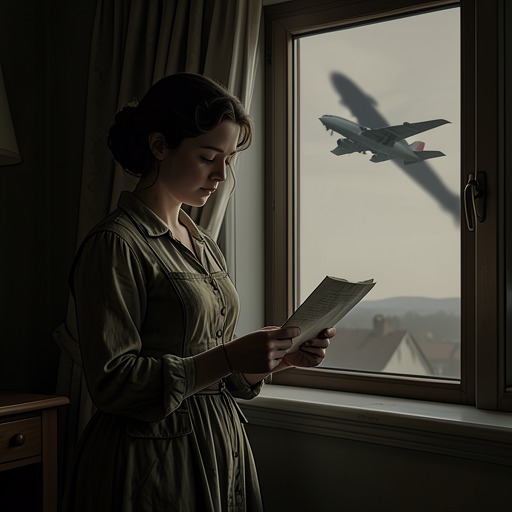
The most vivid encounter with the Royal Air Force occurs when a Stirling bomber flies almost level with the hotel chimneys. The building begins to vibrate, the village dogs bark, and people rush outside to discover the cause of the phenomenal racket. The aircraft is so low that the narrator can clearly see the pilot and crew’s faces. They wave to her, and she waves back from the car park, turning a machine of war into a moment of intimate contact between the aircrew and the people below.
The gesture also violates the boundaries imposed by wartime discipline and by the narrator’s father. He identifies the pilot, Max, as the main culprit and demands an apology, which is later obtained. The narrator is blamed for encouraging the episode, while a later explanation suggests that the flight may have been preparation for a raid intended to destroy a German dam. The incident therefore holds together exhilaration and reprimand, personal excitement and operational danger. Max’s later death in his Stirling bomber, on a raid over Germany, gives the earlier spectacle a tragic afterlife: the smiling airman who once waved from the sky becomes one of the young men never seen again.
Romance, Surveillance, and Gender
The Royal Air Force also structures the narrator’s first great romance. David is a regular visitor to the cocktail bar before appearing in his Royal Air Force uniform, which makes his attractiveness inseparable from the authority and danger of his role. The narrator is immediately smitten, and the feeling appears mutual. Because her father forbids her from going out with young men or being alone with them, she and David devise a deception, claiming that she will go out with Gloria rather than revealing the presence of an RAF admirer.
Their courtship briefly transforms the hotel into a private dance floor. After the narrator serves a meal to David and his friends upstairs, the tables are pushed back and David sweeps her into his arms. At the end of the evening she is permitted to walk onto the car park to say goodnight. David is twenty-four and the narrator is seventeen; they kiss once beneath a not-yet-dark sky while his friends wait in the car. She decides that he is the boy she will marry, and the couple promise to take care of themselves and remain safe. The promise is immediately placed under the pressure of wartime service, since circumstances soon prevent David from keeping his side of it.
The service’s presence intensifies patriarchal control as well as romantic possibility. Surrounded by dashing young airmen, the narrator faces rules that become still more draconian: she cannot walk out of the hotel or onto the car park with any of them and must never be alone with a young man. The Royal Air Force thus marks a boundary between the narrator’s expanding emotional life and the paternal surveillance that attempts to regulate it. Uniform, military duty, sexuality, and danger are brought into the same confined social space.
Premonition and Loss
David’s disappearance is experienced before it is formally confirmed. On September 5, 1941, while attending friends’ wedding in Dudley with Gloria, the narrator is overcome by a feeling of doom so powerful that she becomes physically ill. She tells Gloria that she is certain her beloved has just died, although she cannot explain how she could know. The narrative stresses the disturbing certainty of the foreboding: she does know, and she is right.
The later confirmation turns private intuition into wartime knowledge. David’s laughing smile and carefree manner remain in the narrator’s heart, but the loss leaves her feeling that her heart will break. His death belongs to a larger pattern in which RAF service repeatedly converts youthful promise into absence. The fate of David and the subsequent death of Max make the service a mechanism of separation as much as a symbol of courage, while the dwindling group of twenty airmen gives the losses a cumulative, almost ritual form.
Ambition, Marriage, and the Home Front
The Royal Air Force shapes the lives of those who serve and of those who wait for them. John returns from Scotland intending to be posted to Canada for further training, and his ambition to fly appears to bring him closer to the life he wants. Because of the posting, his marriage to the narrator must be arranged at very short notice, requiring a special licence. The couple use a suitcase of clothes placed with a willing local resident to create the appearance of residence within the parish of St Kenelm’s Church at Romsley, allowing them to marry there despite living in Halesowen.
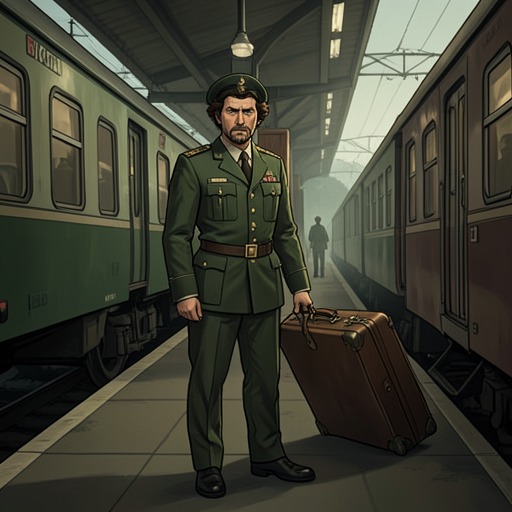
The wedding itself places civilian improvisation beside military identity. The narrator assembles a pale blue woollen Berketex suit from ration coupons, with a tan hat, tan shoes, and a corsage of pink roses, while John wears his RAF uniform. The uniform gives the ceremony the visual presence of service and duty, but it cannot guarantee that John will become the pilot he hopes to be.
An eye test reveals that John is colour-blind and cannot reliably distinguish green from blue, land from sea. Since that inability could prove lethal to a pilot and his crew, his dream of flying is shattered. He never reaches Canada; instead, he is posted first to Anglesea and then to Aden, where he remains until well after the war. The result is an ironic reversal within the RAF story. The service takes David and Max into lethal airborne operations, while it denies John the airborne future he desires. His subsequent life is shaped by the proximity of military danger without the fulfilment of the identity he had imagined at the controls of a Spitfire.
The narrator’s own wartime labour is likewise reorganised by marriage. After John’s wedding, her factory job is terminated on the grounds that her hours will not fit the domestic requirements supposedly demanded by her new role as wife. The contrast is telling: the RAF requires men for dangerous national service, while civilian institutions redirect women toward domestic responsibility. Later, when the narrator gives birth to a daughter on April 10, John is granted a week’s leave to see them, but he does not attend the birth, as was customary at the time. Their family life therefore remains mediated by service postings, limited possessions, parental housing, and the routines of wartime separation.
National War and Collective Feeling
The Royal Air Force belongs to the wider system of violence that reaches far beyond the hotel. The bombing of Coventry on November 14, 1940, and the attacks on other cities demonstrate the scale of the air war, as German bombers target both human beings and the architectural heritage of places such as Bath, Canterbury, York, Norwich, and Exeter. The RAF is not described through a single battle narrative; instead, its meaning emerges against the continuous bombing, the uncertainty of operations, and the shared fear that the population may be broken.
Yet the book does not reduce wartime feeling to terror. War binds strangers together through a common enemy, lowering ordinary reserve and prompting people to chat, offer lifts, and help one another. The RAF’s airmen are part of this collective emotional economy: their courage sustains pride and hope, while their deaths create grief that is absorbed into family and community life. On VE-Day, streets fill with bunting, Union Jacks, trestle tables, sandwiches, trifles, jelly, cake, fireworks, and bonfires. The celebrations represent freedom from tyranny, but they are shadowed by families still waiting for news of missing servicemen. At John’s parents’ home, the safety of John, Derek, and Megan cannot compensate for the silence surrounding Rex, whose whereabouts remain unknown. The service therefore remains present even in victory: its survivors make celebration possible, while its missing and dead prevent victory from becoming uncomplicated joy.